Akhand Bharat (Undivided India) is not only the cradle of Sanatan Dharma and its customs and traditions, but also the land of countless wonders and secret regions beyond the reach of modern science and technology. It is the birthplace of a spiritual world filled with divine experiences that make one’s hair stand on end. It is the rainbow of existence for Hindu Dharma. Long ago, Lord Parameshwara established His eternal abode on the land of Akhand Bharat, placing His divine presence on Mount Kailash of the earthly realm. There, He protected Sanatan Hindu Dharma, all living beings, and the entire creation. By the grace of Lord Brahma, the first sacred lake—the Manasa Sarovar—emerged from His own mind.
This lake became a heavenly abode, bestowing extraordinary results to Shiva devotees and pilgrims coming from far and near. The fact that the Kailash-Manas Sarovar has been glorified and praised through countless ages is truly remarkable.
Preface
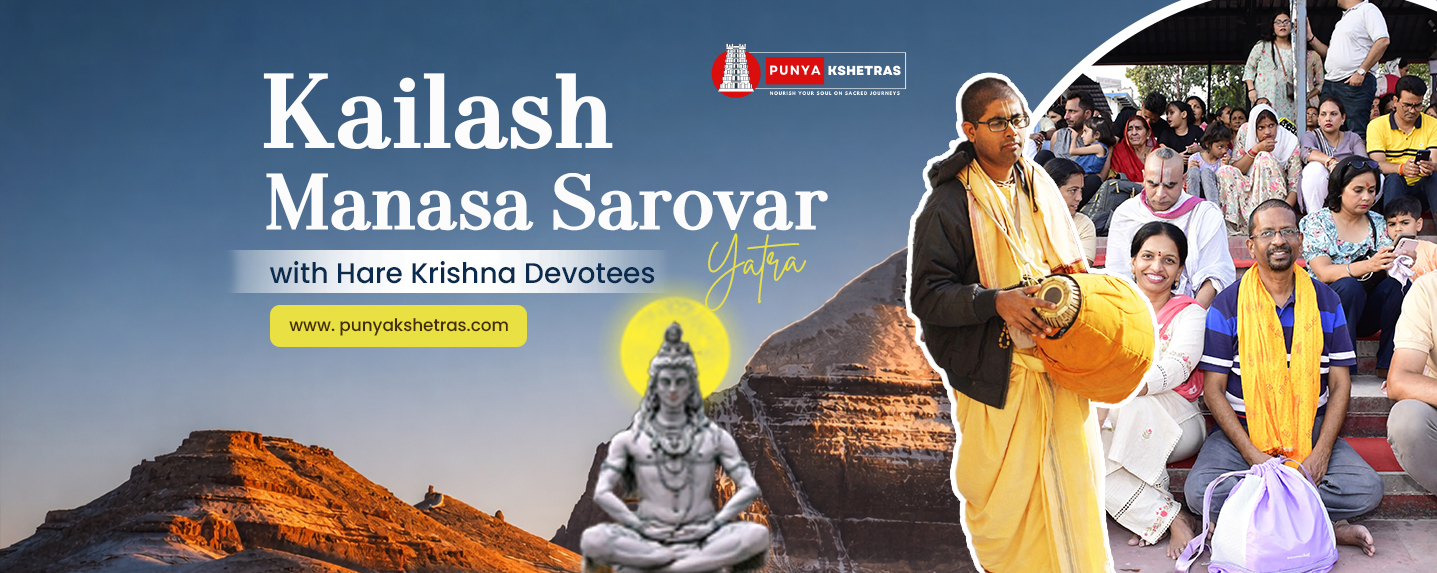
Mount Kailash is the sacred region revered as Bhulok Kailash—the earthly abode—where Lord Paramaśiva Himself, the destroyer of countless worlds and the supreme deity worshipped by Hindus, resides along with Goddess Parvati and His divine family. Lord Paramaśiva is the supreme controller of material nature; therefore, Lord Parameshwara is the master who controls the forces of physical nature. He is called Mahadeva, the greatest among the gods. He is the lord of Tamo Guna (the mode of inertia). At the time of cosmic dissolution, the supreme God of all gods, Lord Krishna, dissolves the entire material creation according to His divine will.
Goddess Parvati, the eternal consort of Lord Paramaśiva, assists Him in the administration of the material universe. Manifesting as Goddess Durga, she oversees the three modes of material nature—sattva, rajas, and tamas—and binds living beings according to their karma. In this manner, Shiva and Parvati function as representatives of the Supreme Lord in governing the material cosmos.
Mount Kailash is situated in the northeastern direction, which is presided over by Lord Kubera, the treasurer of the gods. From a geographical perspective, Mount Kailash is located in the Trans-Himalayan region of Tibet, close to the borders of China, India, and Nepal, at an elevation of 6,638 meters above sea level. From this sacred mountain originate four of Asia’s great rivers: the Indus, Sutlej, Brahmaputra, and Karnali (known in India as the Ghaghara). For this reason, Kailash stands not only as a spiritual landmark but also as a vital lifeline for human civilization.
Mount Kailash is also known as Sītācala, meaning “the completely white and pure mountain.” Every year, thousands of devotees undertake the Kailash–Manasarovar pilgrimage. This sacred journey is performed to receive the grace of Lord Shiva, the greatest of Vaishnavas and the most beloved devotee of Lord Vishnu.
Near Mount Kailash lies Lake Manasarovar, renowned as one of the holiest freshwater lakes in the world. According to Hindu mythology, this lake emerged directly from the mind of Lord Brahma; hence, it holds immense mythological and spiritual significance. The lake is situated at an altitude of approximately 4,600 meters, or about 15,100 feet, above sea level.
Mount Kailash is not merely an ordinary mountain. Followers of Hinduism, Buddhism, and Jainism regard it as the axis point that connects heaven and earth, as well as the central point of the universe. This belief arises from its status as a powerful spiritual centre, its recognition as the abode of Lord Shiva, its perception as a source of cosmic energy, and its unique geographical position combined with its profound spiritual importance. For these reasons, Mount Kailash is revered as the centre of the world.
History & Significance
- While narrating the story of creation, Lord Brahma explained to Sage Narada the origin of Mount Kailash. In the beginning, he said, the entire creation existed only as a vast expanse of water. Thereafter, a great cosmic egg containing the twenty-four fundamental principles (tattvas) came into existence. To infuse consciousness into this cosmic egg, Lord Brahma performed intense penance for twelve years and pleased Lord Vishnu. Satisfied with Brahma’s austerities, Lord Vishnu manifested Himself and entered the cosmic egg. As a result, all the worlds were revealed, including Mount Kailash.
Therefore, Mount Kailash is not an ordinary mountain—it is a divine manifestation brought into existence by the will of the Supreme Being.
- The way Lord Shiva chose Kailash as His abode.
Hearing this story, Narada asked
“When did Lord Shiva choose Kailash as His abode? How did His friendship with Kubera come about?” In response, Lord Brahma explained this story:
In the city of Kampilya, there lived a great scholarly Brahmin named Yajñadatta. He was an expert in performing Soma Yajñas. He had a son named Gunānidhi. Though learned, Gunānidhi fell into sinful activities such as keeping bad company and gambling. Out of motherly affection, his mother concealed his faults. Unaware of the truth, Yajñadatta arranged his marriage. Yet, Gunānidhi did not change his ways. One day, when Yajñadatta saw his ring in the hands of a gambler and questioned him, he came to know that Gunānidhi had lost everything in gambling. Enraged, he renounced both his wife and his son.
Wandering in repentance, Gunānidhi reached a Shiva temple. Though tormented by hunger, he witnessed the worship being performed there on the occasion of Maha Shivaratri. When the lamp in the temple began to dim, he tore a piece of his cloth and used it as a wick to brighten the flame. This became a great act of service to Lord Shiva, performed unknowingly.
When he attempted to take the sacred offering (prasadam), he was caught, beaten, and died. As the messengers of Yama arrived, the attendants of Lord Shiva appeared and stopped them. They declared that since he had observed the Shivaratri fast, listened to the glory of Shiva, and offered service by lighting the lamp, he was a virtuous soul. He was taken to Shivaloka and later was reborn as the king of Kalinga.
Wandering in repentance, Gunānidhi reached a Shiva temple. Though tormented by hunger, he witnessed the worship being performed there on the occasion of Maha Shivaratri. When the lamp in the temple began to dim, he tore a piece of his cloth and used it as a wick to brighten the flame. This became a great act of service to Lord Shiva, performed unknowingly.
When he attempted to take the sacred offering (prasadam), he was caught, beaten, and died. As the messengers of Yama arrived, the attendants of Lord Shiva appeared and stopped them. They declared that since he had observed the Shivaratri fast, listened to the glory of Shiva, and offered service by lighting the lamp, he was a virtuous soul. He was taken to Shivaloka and later was reborn as the king of Kalinga.
- The true abode of Lord Shiva:
This earthly Kailasa is only a reflection of Lord Shiva’s eternal abode. His true residence is Mahesha Dhama, which lies at the boundary of Vaikuntha.
- The Brahma Samhita (5.43) states thus:
Govinda is the original Supreme Person; under His control exist Goloka, Devi-dhama, Mahesha-dhama, and Hari-dhama. - The glory of Kailasa in the Ramayana.”
When Ravan attempted to lift Mount Kailash, Lord Shiva pressed the mountain down with His foot and crushed him beneath it. After Ravan performed penance by singing hymns in praise of Shiva for a hundred years, Lord Shiva showed compassion and released him. From that time onward, Ravan became a devoted worshipper of Lord Shiva.
- According to the Puranas, Rakshastal Lake, located near Manas Sarovar close to Mount Kailasa, is believed to be a cursed place because Ravanasura is said to have cut off his own heads there and spilled blood. Therefore, it is believed that bathing in that lake causes sins to attach to a person, and devotees refrain from bathing there. Rakshastal is a saltwater lake. It lies to the south of Manas Sarovar, very close to it. However, devotees perform sacred baths only in the pure waters of Manasa Sarovara, which is situated near Mount Kailash.
- The Puranas state that after Ravana drove his half-brother Kubera out of Lanka, Kubera settled in a magnificent city called Alakapuri in the Himalayas. It is said that this city of Alakapuri lies to the east of Mount Kailash, the abode of Lord Shiva. It is believed that there, Kubera constantly meditates upon Lord Parama Shiva.
- The Puranas state that by drinking the water of this lake or bathing in it, the sins of a hundred lifetimes are washed away, and after death one attains Shivaloka, the abode of Lord Shiva.
- According to the Vishnu Purana, Mount Kailasa is a divine mountain located near Mount Meru, which is regarded as the axial center of the universe. It is described not as an ordinary physical mountain, but as a supremely sacred, spiritual realm filled with divine radiance. Although Kailasa is primarily known as the abode of Lord Parama Shiva, the Vishnu Purana describes it as a holy region where all deities, great sages, Gandharvas, and Siddhas reside or perform penance. The Purana states that through austerities performed here, sages attain self-realization and liberation (moksha). Kailash is portrayed as an exceptionally suitable place for meditation, yoga, and spiritual awakening, making it an ideal region for inner realization and communion with the Supreme.
- According to the Vishnu Purana, Manas Sarovar is described as a lake whose waters are crystal-clear and supremely pure. The Purana states that bathing in this lake destroys sins and bestows spiritual merit.It is also described that divine sages, great rishis, and siddhas reside near this lake and attain spiritual purification through penance performed on its banks.
- According to Tibetan Buddhist belief, Mount Kailash is regarded as the abode of the deity known as Chakrasamvara (also called Demchok), who symbolizes supreme bliss.”
- “According to Jain tradition, it is believed that Lord Rishabhadeva, the creator of faith, performed penance at this sacred mountain and attained liberation from the cycle of rebirth.”
Prominence & Mysteries
- It is said that when many sages and yogis meditate on Mount Kailash, the natural sound of “Om” can be heard. Moreover, small stones along the shores or even in the waters of the lake appear to naturally bear the shape of “Ohm.” Devotees have also observed that the water near the shore appears blue, gradually changing to green as one moves toward the centre of the lake.
- According to Hindu Puranas, during the Treta Yuga, when Sugriva sent his vanara army in search of Goddess Sita, he described the directions and the regions to be explored. In that geographical description, Mount Kailash is mentioned as being located in the Himalayan mountain range.
- On one face of Mount Kailash, a naturally formed swastika-shaped marking is said to be visible. This is regarded as an auspicious sign and a symbol of divine power.
- It is said that when the sun’s rays fall on Mount Kailash, it not only glows with a golden hue but also shimmers in shades of saffron and blue, creating an astonishing and mesmerizing sight.”
- Mount Kailash naturally appears in the shape of a pyramid. Compared to other mountains in the world, it has a uniquely distinct form.”
- It is said that this mountain is associated with four vehicles in the four directions. In other words, the mountain is believed to resemble the vehicles of the deities: a lion, an elephant, a horse, and a peacock. In this symbolism, the lion represents the vehicle of Goddess Parvati, the elephant represents Lord Ganesha, the horse represents Lord Hayagriva, and the peacock represents Lord Kartikeya (Kumara Swami).”
- According to Hindu Puranas, Mount Kailash is considered a pathway to heaven. This is also mentioned in the Mahabharata. After the Kurukshetra war, the five Pandava brothers and Draupadi, having ruled the kingdom of Hastinapura for several years, set out on a journey to heaven. In this journey, Yudhishthira (Dharmaraja), accompanied by his dog, ascended the steps of Mount Kailasa in his physical body to reach heaven, while the other brothers and Draupadi reached the same destination in their spiritual forms via the same pathway.
- “It is said in the Puranas that Kubera, from atop this mountain, travels to the earthly and heavenly realms using his vehicle, the Pushpaka Vimana.”
- If Mount Kailash is approximately 6,666 kilometers from the North Pole, it is noteworthy that it is also the same distance from Hedlenz, a historically significant location. Furthermore, the distance from the South Pole to the North Pole is exactly double, i.e., 13,333 kilometers, which is also remarkable.
- It is said that on Mount Kailash, phenomena such as rapid hair and nail growth occur. This is believed to be due to the powerful magnetic field or spiritual influence surrounding the mountain.
- There is a theory that Mount Kailash functions as an extremely powerful field, possibly connected to other dimensions or parallel universes, which is why time behaves in unusual ways there. However, it is also suggested that these effects may result from a combination of spiritual energies, magnetic influences, intense emotions experienced during the journey, and profound spiritual experiences.
- According to spiritual gurus, at Mount Kailash, time does not flow according to clocks but according to one’s karma.”
- Although Mount Kailash stands at an altitude of 6,638 meters, which is lower than Mount Everest, no one has successfully climbed its summit so far. Mountaineers who attempted to ascend have encountered strange and unusual experiences; some lost their way, while others had to turn back due to sudden changes in weather. It is believed that only an ancient Buddhist sage named Milarepa, in the 18th century, reached the summit through intense penance and devotion to Lord Shiva.
- At the base of Mount Kailasa lie Manas Sarovar, a sacred freshwater lake, and Rakshastal, a saltwater lake associated with demons, known for its turbulent nature. Although the two lakes are located side by side, they possess completely opposite characteristics, which remains a mystery.
- It is said that on every full moon day, from midnight to sunrise, many pilgrims have observed strange rays of light or star-like glows descending into the lake from the sky. According to the Puranas, Hindus believe that during this time, the deities and the Saptarishis come to the lake to take a holy bath.
- To find out what exactly exists atop Mount Kailash and why no one has been able to reach its summit, a few years ago, the Chinese government made a daring decision. They prepared to send a helicopter expedition with a team of meteorological experts to approach the mountain. As they began their journey and neared the mountain, they observed extremely frightening changes in the weather. Sudden shifts in atmospheric conditions, thick clouds enveloping the area, violent snowstorms, rising wind pressures, and rapid heartbeat among the crew caused the helicopter to start losing control due to the extreme environmental conditions near the mountain.
In the end, with nothing else to do, the meteorological team had to turn back. However, they concluded that some extraordinary and powerful force exists atop Mount Kailash, leading them to this remarkable inference about the mountain.
- Later, in 2015, NASA from the United States also began research on Mount Kailasa. A team of scientists attempted to land a helicopter on the mountain, but the weather did not cooperate. They reported witnessing something astonishing atop the mountain—a figure appearing in a meditative posture, as if in deep contemplation. They described it as the Lord of Kailash, and remarked that the sight of this form was truly extraordinary.