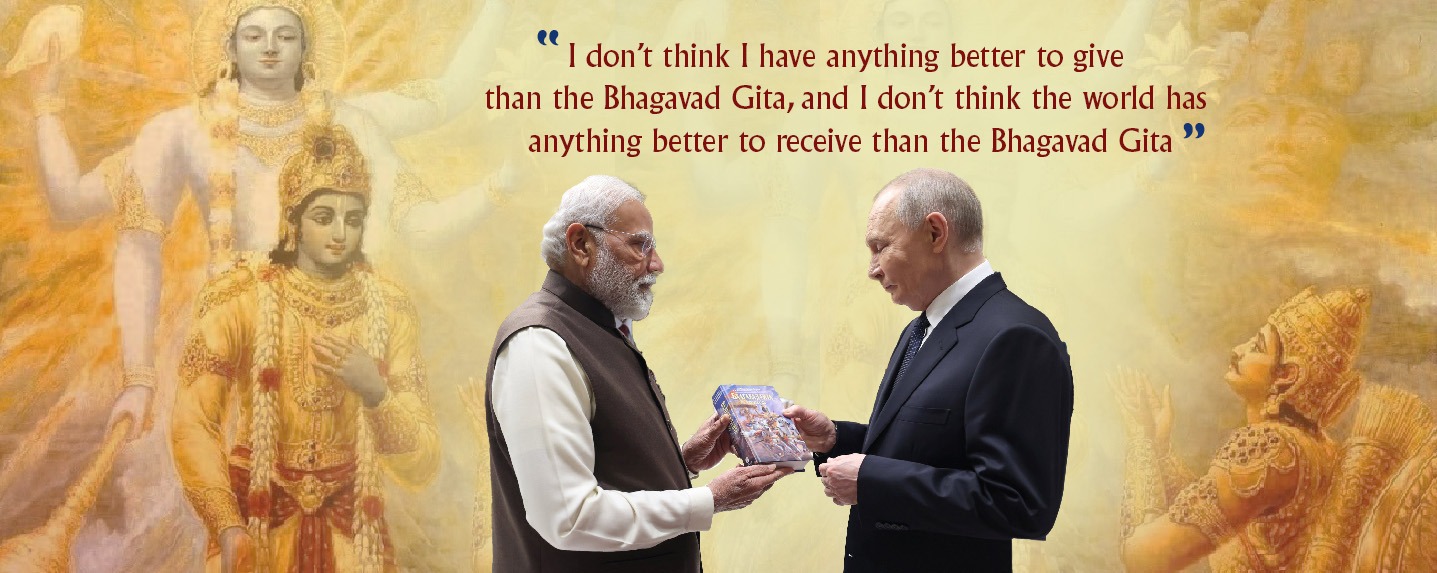
When Prime Minister Narendra Modi presented a copy of the Bhagavad Gita to Russian President Vladimir Putin, it wasn’t simply an exchange of gifts. It was a moment that reminded the world of India’s civilizational roots. A moment that showed how our leaders often communicate through culture, not just diplomacy.
The Bhagavad Gita carries a presence far beyond its 700 verses. It is a guide for clarity, purpose, and fearless action. So when a national leader chooses it as a diplomatic gift, it becomes a message about India itself — a land where knowledge is sacred, and wisdom is meant to be shared.
A Gift That Radiates India’s Soul
Modi has often said that he has nothing better to offer the world than the Gita. Those words reflect India’s belief that true wealth lies not in material abundance but in spiritual insight.
Gifting the Gita is a way of sharing India’s identity — one shaped by dharma, devotion, and a deep commitment to inner growth. It speaks to everyone, regardless of nationality or belief. Leaders, thinkers, and seekers across centuries have turned to it when faced with difficult choices.
At its heart, the Gita is a dialogue about responsibility in a complicated world. And that makes it a powerfully relevant gift for any global leader navigating modern challenges.
Diplomacy Meets Dharma
Here’s the thing. The Gita isn’t a war text; it’s a clarity text. Arjuna is overwhelmed, confused, and emotionally torn. Krishna’s response is a timeless blueprint for how to act without losing oneself.
By gifting the Gita, Modi is offering:
• A reminder that power must be balanced with purpose
• A call to lead with wisdom rather than impulse
• A message that clarity arises from within, not from circumstances
This turns a diplomatic exchange into something deeper — a meeting point between political responsibility and spiritual insight.
Indian Soft Power with Civilizational Depth
At a time when global diplomacy is dominated by negotiations, deals, and strategic alliances, India brings something unique to the table: the ability to communicate through wisdom traditions.
Modi’s gifting choices — from ancient texts to handcrafted artifacts — highlight India’s cultural confidence. The Gita stands at the top of that list because it distills the essence of Indian thought.
It signals three things:
- India sees spirituality as a strength, not a relic.
- Our heritage continues to guide our worldview.
- Wisdom, when shared, creates bridges across nations.
This is soft power rooted not in marketing, but in meaning.
Where the Gita Lives Today: In Temples, Homes, and Spiritual Movements
The relevance of the Gita doesn’t end with diplomacy. It lives in the daily practices of millions, in study circles, homams, and temple teachings.
Organizations like the Hare Krishna Movement Hyderabad (HKM Hyderabad) continue to bring the Gita alive through:
• Gita study programs
• Youth education sessions
• Spiritual discourses
• Homams and cultural festivals
• Community outreach grounded in Krishna Consciousness
Anyone who wants to experience the Gita not just as a book, but as a living tradition, finds a natural home at places like HKM Hyderabad.
(You can explore more at https://hkmhyderabad.org/.)
For many visitors, reading about the Gita is one thing. Hearing it sung, discussed, and practiced is something entirely different — transformative, grounding, and deeply personal.
A Message the World Still Needs
The modern world is noisy and fast. Leaders are under constant pressure. People face overwhelming choices. The Gita offers something rare: a calm voice of clarity.
By presenting it on an international stage, India is sharing a universal truth —
that wisdom is the greatest gift a nation can offer.
Countries share technology, trade, policy frameworks. India shares philosophy. And that makes India’s contribution timeless.
Conclusion: A Gesture That Carries Centuries of Meaning
Modi giving the Bhagavad Gita to Putin is more than symbolic diplomacy.
It is India showing who we are at our core.
It is a reminder that our greatest strength lies in our spiritual heritage.
And it is a statement that the values of dharma, clarity, and compassion still matter in global conversations.
In a world searching for direction, the Gita remains a lighthouse.
Sharing it is not just a gift. It is a service to humanity.